

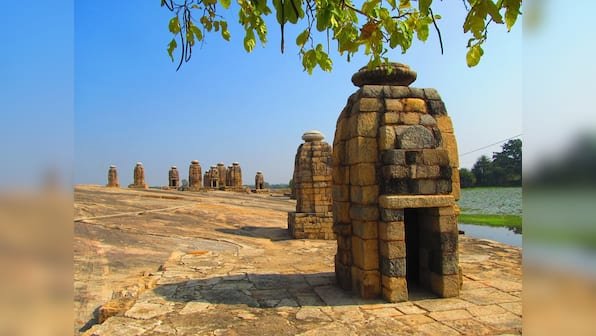
With districts such as Balangir now free from the Naxal menace, revelation of more such Odiya secrets is awaited with bated breath
Of the various parts of India to be overrun by Islamic armies, Odisha was one of the last. In 1360, the Delhi Sultanate ruler Firoz Tughlak penetrated as far as the Jagannath Temple in Puri. The temple was desecrated, its idols broken and carried away. Two centuries later, the immense wealth of the now-revived temple drew another iconoclast, Kalapahad. The temple was again desecrated, but this time, courageous priests managed to save some of the idols. Legend holds that idols were quietly taken out of the temple complex and hidden for their safety. Now, the past seems to be re-emerging.
Recent work during Puri’s Srimandir Parikrama Project saw ground-penetrating radar being used. The results were astonishing! The first rumour that filtered out was of a secret tunnel linking the 12th century Jagannath shrine to the sea. But the truth was much bigger. It began with the finding of two broken stone lions in excavations close to the 11th-12th century Emar Math. As more evidence of subsurface structural remains emerged, an ‘H-zone’ was created encompassing several shrines and as many as 43 spots where underground remains were found. What scholars have begun to realise is that an extensive settlement of ancient origin lies beneath the current city of Puri. Odisha has done a truly fine job of hiding its secrets.
And some of those secrets were not subterranean but tucked away in remote corners. More than four hundred kilometres west of Puri, in Balangir district – once notorious for famine and malnutrition – lies a rocky hilltop that is considered sacred. Located between the villages of Ranipur and Jharial, the hill has a curiously shaped shrine. In a land filled with impressive shikharas and enormous temple complexes, this shrine is small, circular and roofless. This is a Chaunsath Yogini temple, built by a sect that flourished between the 9th and 12th centuries CE. Their shrines follow the unique pattern of the circular Ranipur-Jharial temple and have been found in Madhya Pradesh, Uttar Pradesh and Odisha. Invariably, their location is remote, and even there, not within an inhabited area but outside it.
According to historian Vidya Dehejia, the Yoginis are manifestations of the Mother Goddess and are Tantric in nature. As per mythological stories, when the goddess was in the middle of a battle with an overwhelming demon army, various goddesses emerged from her and joined battle. As per the popular 15th-century Odiya poet Sarala Das, who is credited with writing a ‘Chandi Purana’, sixty-four Yoginis were formed from different parts of Durga’s body, such as her cheeks, lips, ears, toenails, womb and even her voice and sweat. This number explains why the Ranipur-Jharial temple is called ‘Chaunsath Yogini’.
From the outside, the circular shrine is entirely plain – it is a wall of rocks with a gap for a doorway. In the middle of the courtyard is a central shrine, and built into niches of the courtyard wall are the Yoginis. Voluptuous in form, each Yogini represents a different quality of the Goddess and is symbolised by a unique weapon or mounted on a different creature. While one yogini has the face of a leopard, another is of a cat, a third of a snake, a fourth of a horse and so on.
In a religious context, the Yoginis were considered worshippers of Shiva. Here in this lonely spot, it appears as if the Yogini idols are circumambulating around the central Shiva shrine. With no roof, it is eerie to imagine Tantric prayers here under a starry sky. The place has the ingredients of a Da Vinci Code-like thriller and awaits its chronicler.
At the edge of the hill, close to a pond, is another shrine – the Someshwara. As the name suggests, it is dedicated to Shiva and is as old as the Yogini shrine, if not older. Perhaps drawing from the sacred nature of this spot with two shrines of such antiquity, faithful people began building smaller shrines all over the hill. Strangely, none of these have any idols within. A short distance away is another striking structure. The Indralath Temple is unique in being the only structure here made of bricks. Built in the early 10th century or earlier, this is an example of the ‘Rekha Deul’ style of temple design seen more in West Bengal. Possibly, the Somavamshi dynasty that patronised the creation of this temple borrowed an architect from Bengal. It is astonishing that in this spot, miles off the beaten track in Odisha, are temples in three distinct building styles. Ranipur-Jharial is a secret Odisha has kept well.
On World Heritage Day, it is appropriate to acknowledge that Ranipur-Jharial’s temple is not the only Yogini shrine in this state. Just outside the capital, in Hirapur village, is another circular shrine complete with its idols. Smaller in size than its Ranipur-Jharial sibling, the Hirapur temple is of the same antiquity and was discovered only in the 1950s. Back in Puri’s Emar Math, an investigation into a burglary in 2011 revealed a hidden chamber containing silver slabs weighing a total of more than 18 tonnes, with a (then) market value of nearly one hundred crore rupees. With districts such as Balangir now free from the Naxal menace, revelation of more such Odiya secrets is awaited with bated breath.
(The author is a heritage explorer with a penchant for seeking obscure sites. A brand consultant by profession, he tweets @HiddenHeritage.)
First Published:
April 19, 2026, 10:38 IST
End of Article