

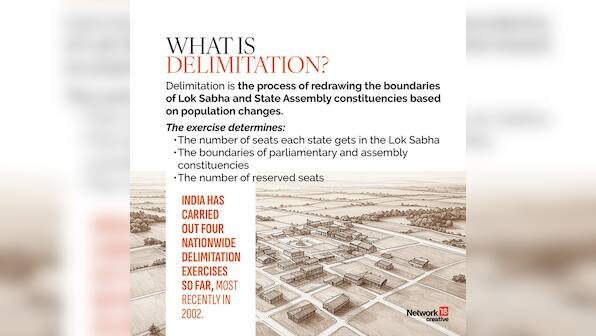
Delimitation has emerged as a major bone of contention between the Centre and the Opposition. The Centre is geared up to move the three bills — the Constitution (One Hundred and Thirty-First Amendment) Bill, 2026, the Delimitation Bill, 2026 and the Union Territories Laws (Amendment Bill), 2026 — for passage in the Lok Sabha today (April 17) following their introduction in the Lower House a day back during the ongoing special sitting of Parliament.
The Opposition leaders, particularly those in southern states, are at odds with the Central government led by the Bharatiya Janata Party (BJP) over the delimitation proposal. The government has tried to assuage the concerns of southern states, but the Opposition remains on edge over the redrawing of constituencies based on the 2011 Census.
Let’s take a closer look.
What is delimitation?
Delimitation is the act of drawing boundaries of constituencies and fixing the number of seats in each state for the Lok Sabha and the Legislative Assemblies.
It has been a longstanding point of dispute between the Centre and southern states. Article 82 of the Constitution states that the number of Lok Sabha seats to each state should be readjusted after every Census.
The constituencies have to be redrawn and seats reallocated after each census to reflect the updated population count.
India carried out delimitation based on the decennial census in 1951, 1961 and 1971. However, the exercise was later put on hold by subsequent governments to encourage population control measures and avoid more representation in the Lok Sabha for states with higher populations.
On Thursday (April 16), the Centre tabled three bills in the Lower House that would pave the way for a fresh delimitation exercise, the rollout of
one-third reservation for women in the Lok Sabha and state Assemblies and expand the Lok Sabha size from the existing 543 seats to 850.
The government has linked the delimitation exercise to the implementation of the Women’s Reservation Act.
Why is Opposition at loggerheads over delimitation?
Opposition leaders have expressed fear over the delimitation exercise, arguing it could lead to southern states losing out on representation in the Lok Sabha, and hence clout at the Centre.
Leaders from southern states say that if the readjustment of seats is done solely on the basis of population, then their states will be “penalised” for their success in family planning, while northern states like Uttar Pradesh will gain a significantly higher number of seats in the Lok Sabha.
On Thursday, Telangana Chief Minister A Revanth Reddy called on leaders of the INDIA bloc to vehemently oppose the Centre’s bid to redraw constituencies and expand the Lok Sabha seats in an “irrational” manner.
As per The New Indian Express (TNIE) report, he met MPs from Congress, DMK, Samajwadi Party, CPM, CPI and other like-minded parties in Delhi and explained to them how the delimitation bill would harm certain states if implemented in its present form, reducing the political representation of southern states in the Lok Sabha.
Karnataka Chief Minister Siddaramaiah and Kerala Chief Minister Pinarayi Vijayan have also echoed Reddy’s concerns.
Tamil Nadu Chief Minister MK Stalin has described the delimitation proposal as a “massive historic injustice”. He held a protest on Thursday in the town of Namakkal, where he hoisted a black flag and burned a copy of the proposed bill.
Stalin also called on party workers and supporters to fly black flags at their homes. Previously, he had issued a “final warning” to Prime Minister Narendra Modi, saying Tamil Nadu would “rise” if its representation were reduced.
Tamil Nadu is going to the polls next week, with the delimitation issue providing fodder to the DMK’s election narrative.
“We support reserving 33 per cent seats for women based on the current strength of parliament. We also want a further freeze on expanding overall seats in the parliament until population trends stabilise. We object to the haste in convening this session in the middle of an election season,” John Brittas, Communist Party of India (Marxist) MP, told BBC.
In Telangana, Bharat Rashtra Samithi (BRS) leader KT Rama Rao (KTR) has warned that the Centre’s proposal could trigger a “strong people’s movement across Southern India,” cautioning that the region would not remain a “mute spectator” if its political voice were weakened.
Speaking in the Lok Sabha on Thursday, Congress leader Priyanka Gandhi Vadra accused the Central government of undermining democratic institutions and called the bill an “open attack” on democracy. She also questioned why the 33 per cent women’s quota could not be implemented within the existing 543-member Lok Sabha.
What has the government said?
Union Home Minister Amit Shah on Thursday dismissed the concerns of southern and smaller states and said fears that the South’s
share in the Lok Sabha would go down was “completely false”.
He said, instead, the exercise would expand both seats and influence. “The number of seats will go up and power will grow,” Shah assured.
VIDEO | In Lok Sabha, Union Home Minister Amit Shah says, “A narrative is being created and confusion is being spread that these three bills, the Constitutional Amendment Bill and the two related laws on delimitation and changes in election procedures, will reduce the… pic.twitter.com/Tpqa8PaaIg
— Press Trust of India (@PTI_News) April 16, 2026
The home minister said that southern states have 129 MPs in the 543-member Lok Sabha, making up 23.75 per cent of the total number of lawmakers. This will rise to 195 MPs in the expanded Lok Sabha, enhancing representation to 23.9 per cent.
According to the home ministry, Karnataka, which currently has 28 seats in the Lok Sabha and 5.15 per cent representation, will see its number of seats surge to 42, with 5.14 per cent representation in the expanded House, following delimitation.
For Andhra Pradesh, the number of seats in the Lok Sabha will increase from the current 25 to 38, with a negligible change in representation from 4.6 per cent to4.65 per cent.
The number of Lok Sabha MPs from Tamil Nadu will jump from 39 to 59, increasing the southern state’s share in the Lower House from 7.18 per cent to 7.23 per cent after delimitation.
Kerala’s Lok Sabha seats will spike from 20 to 30, with its representation in the House changing from 3.68 per cent to 3.67 per cent.
Telangana, which has 17 seats and a 3.13 per cent representation in the Lok Sabha, will see its seats rise to 26, representing 3.18 per cent of the expanded House.
Addressing the Lok Sabha yesterday, Prime Minister Narendra Modi also assured that southern states would not be “penalised” for successfully implementing population control measures.
He said, “I give my guarantee… no injustice will be done to any state, from east to west, north to south.”
Government sources have earlier said that the number of seats in the Lok Sabha for each state will increase by 50 per cent on a “pro-rata” basis, meaning each state’s seats would rise in proportion to its current share.
However, the Centre’s guarantees have not convinced the Tamil Nadu’s CM, who called on the government on Friday to “completely withdraw the Delimitation Bill”.
With inputs from agencies
First Published:
April 17, 2026, 13:07 IST
End of Article